
Teams don’t lose trust in AI because it occasionally makes a mistake. They lose trust when the system behaves unpredictably under pressure: a data edge-case, a policy change, a high‑stakes workflow, a new integration, a quarter‑end rush.
“Guardrails” shouldn’t be a disclaimer or a line in a prompt. Guardrails are a layered system that makes your assistant more capable by defining what it can safely do, what it must verify, and what it should route to a human.
The mistake: treating safety as a single knob #
Most teams start by tweaking the prompt:
- “Don’t hallucinate.”
- “Be concise.”
- “If unsure, ask for clarification.”
That helps, but it’s not a system. It’s a hope.
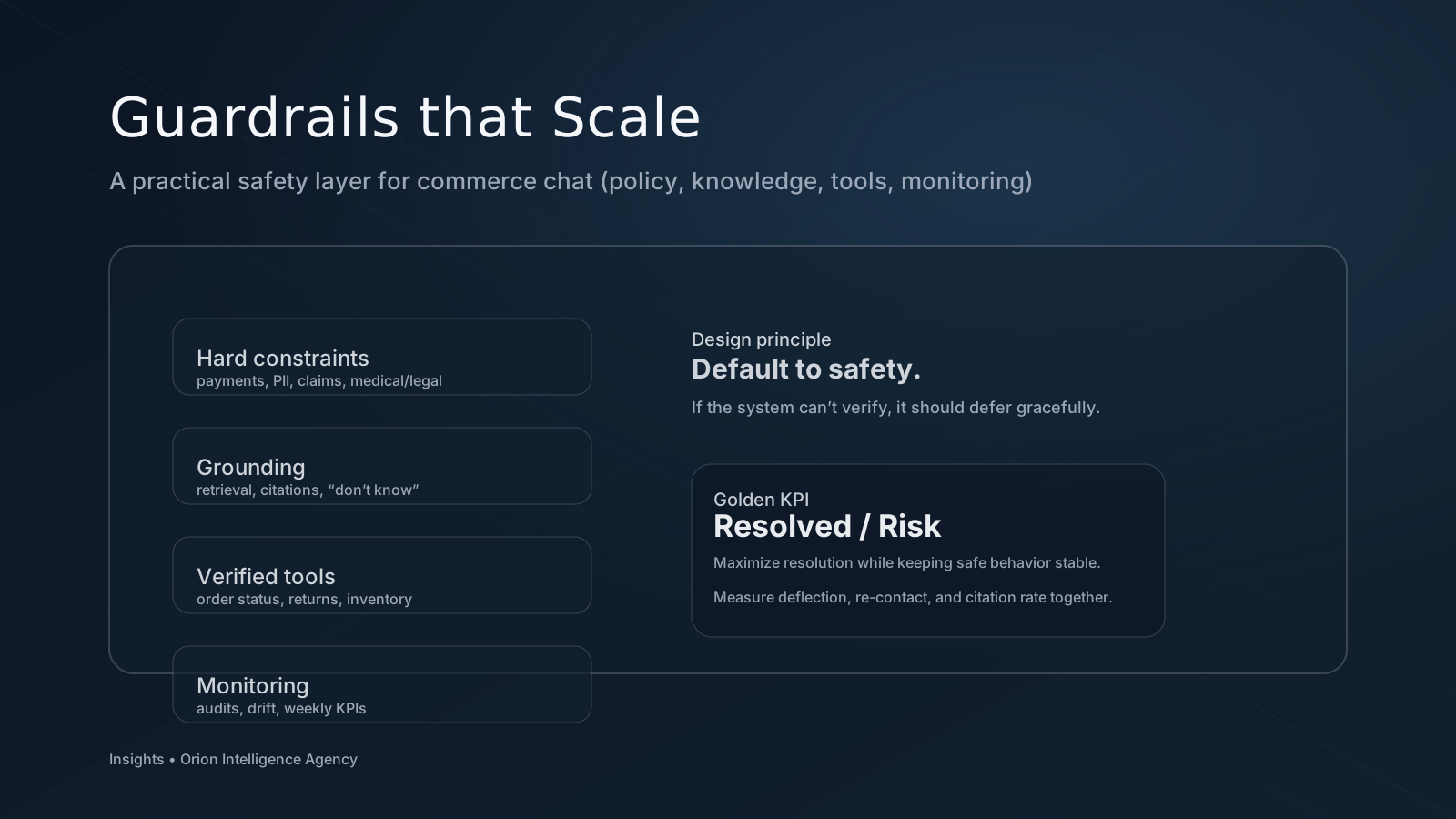
Real safety is architecture:
- Hard constraints for prohibited actions and regulated topics.
- Grounding so answers come from your policies and catalog, not vibes.
- Verified tools so the assistant can check order status rather than guess.
- Monitoring so drift shows up in a weekly email—not in a chargeback thread.
Layer 1 — Policy constraints (what must never happen) #
This is your “refuse or defer” layer. It should be deterministic and testable.
Common examples (adapt to your industry):
- Payments / PCI: never request or store full card data in conversational flows; route to secure checkout or approved payment rails.
- PII: avoid collecting unnecessary personal data; redact where possible; be explicit about what’s needed.
- Medical / legal: refuse and suggest professional help.
- Competitor claims: avoid unverifiable statements.
Implementation tip: treat this as classification + routing. You don’t need the model to “decide morally”; you need it to follow policy. (This is aligned with the “govern, map, measure” structure in the NIST AI RMF.)
Layer 2 — Grounding (what must be verifiable) #
When an assistant is allowed to answer, the question is: based on what?
Grounding makes answers traceable to your sources:
- Policy pages (shipping, returns, warranties)
- Product catalog (variants, sizing, compatibility)
- Promotions (start/end dates, exclusions)
- Support macros and “known issues”
Practical grounding tactics:
- RAG with coverage, not just relevance: index the right documents, ensure top intents have sources, and measure “no good source found.”
- Citations: not for vanity—citations are your canary. If citation rate drops, your KB is drifting.
- Freshness rules: promotions, inventory, and delivery timelines have short half‑lives. Prefer live tools over static docs.
Layer 3 — Verified tools (what must be checked, not guessed) #
The highest‑leverage move in business automation is to replace free‑text guessing with verified calls:
- Order and account status
- Policy eligibility checks
- Inventory and provisioning
- Billing and subscription state
- Ticket creation / routing
- Scheduling and handoff
The assistant becomes a workflow with guardrails, not a chatbot. If the tool fails or returns low-confidence data, the system should degrade gracefully (ask for an order number, offer human help, or provide the policy link).
Layer 4 — Monitoring (what must be observed weekly) #
Guardrails are only real if you can see them working.
Minimum weekly visibility:
- Resolution rate (how many conversations end successfully)
- Deflection (how many avoid a ticket and don’t boomerang back)
- Re-contact within 7 days (proxy for “it didn’t actually solve it”)
- Citation rate on policy/product answers (proxy for grounding health)
- Escalation rate + top reasons (proxy for coverage gaps)
- Incident review queue (a small sample of high-risk conversations)
This is the difference between “AI as a feature” and “AI as an operation.”
A simple “safe by default” playbook #
If you want one rule that scales, use this:
If the assistant can’t verify, it should defer—helpfully and specifically.
Examples of good deferrals:
- “I can help, but I need your order number to check shipping status.”
- “Returns depend on the purchase date—here’s the policy, and I can connect you with support if you’d like.”
- “I don’t have enough information to confirm compatibility. Here are the specs; tell me your device model and I’ll verify.”
What to do this week #
- Write your policy as code: a list of prohibited categories + the exact response behavior.
- Make one verified tool call live (order status is usually the best first win).
- Add a weekly KPI email (even a simple one) and review it as a team.
If you want help building this into a production-grade system, start with a strategy call: Book a Strategy Call.